
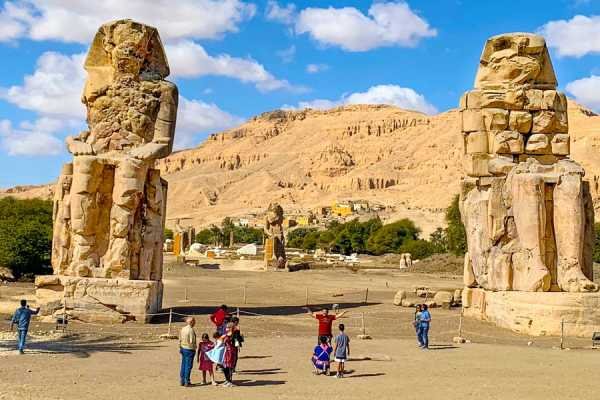
Egypt is not only about the pyramids and the Nile—it is also home to two of the most mysterious and awe‑inspiring monuments: the Colossi of Memnon.
Standing on the west bank of the Nile in Luxor, these twin statues of Pharaoh Amenhotep III have watched over the ancient city of Thebes for more than 3,400 years.
This article explores the legends, history, and significance of the Colossi of Memnon and why they should be on your Egypt travel list.
The Singing Statues
In antiquity, travelers reported that one of the statues would “sing” at dawn, producing a mysterious sound as the stone warmed under the morning sun.
This phenomenon fascinated the Greeks and Romans, who linked the statues to Memnon, a mythical hero of the Trojan War.
The legend gave the site its name and turned the Colossi into one of the most famous attractions of the ancient world.
Historical Background
- Built during the reign of Amenhotep III (14th century BC)
- Originally flanked the entrance to his mortuary temple, once the largest in Thebes
- The temple was destroyed over time, but the statues survived, becoming symbols of endurance
- Ancient inscriptions left by Greek and Roman travelers can still be seen on the statues today
Architectural Highlights
- Each statue is nearly 18 meters high, carved from single blocks of quartzite sandstone
- They depict Amenhotep III seated, hands resting on his knees, gazing east toward the rising sun
- Despite centuries of damage, their monumental presence remains awe‑inspiring
Location
The Colossi of Memnon are located on the west bank of Luxor, near the Valley of the Kings and the Temple of Hatshepsut.
They are easily accessible and often included in guided tours of Luxor’s ancient monuments.
Cultural and Spiritual Significance
The Colossi are more than statues — they are guardians of memory, linking Egypt’s grandeur with myths that traveled across cultures.
For visitors today, they represent both the power of ancient Egypt and the mystery of legend, making them a must‑see stop in Luxor.
Frequently Asked Questions (FAQs)
Q1: Why are they called the Colossi of Memnon?
Greek travelers associated the statues with Memnon, a mythical hero, after hearing the “singing” sound at dawn.
Q2: Can visitors get close to the statues?
Yes, visitors can walk right up to the statues and see the inscriptions left by ancient travelers.
Q3: What is the best time to visit?
Early morning or sunset, when the light enhances the statues’ dramatic presence.
Q4: Are the Colossi part of a larger temple?
Yes, they once marked the entrance to Amenhotep III’s mortuary temple, which was larger than Karnak but is now mostly destroyed.
Conclusion
Visiting the Colossi of Memnon is more than a sightseeing stop — it is a journey into history, legend, and mystery.
From their monumental size to their legendary “song,” these statues embody the timeless spirit of Egypt.
Combined with nearby attractions like the Valley of the Kings and Hatshepsut’s Temple, the Colossi of Memnon are an unforgettable highlight of Luxor.