
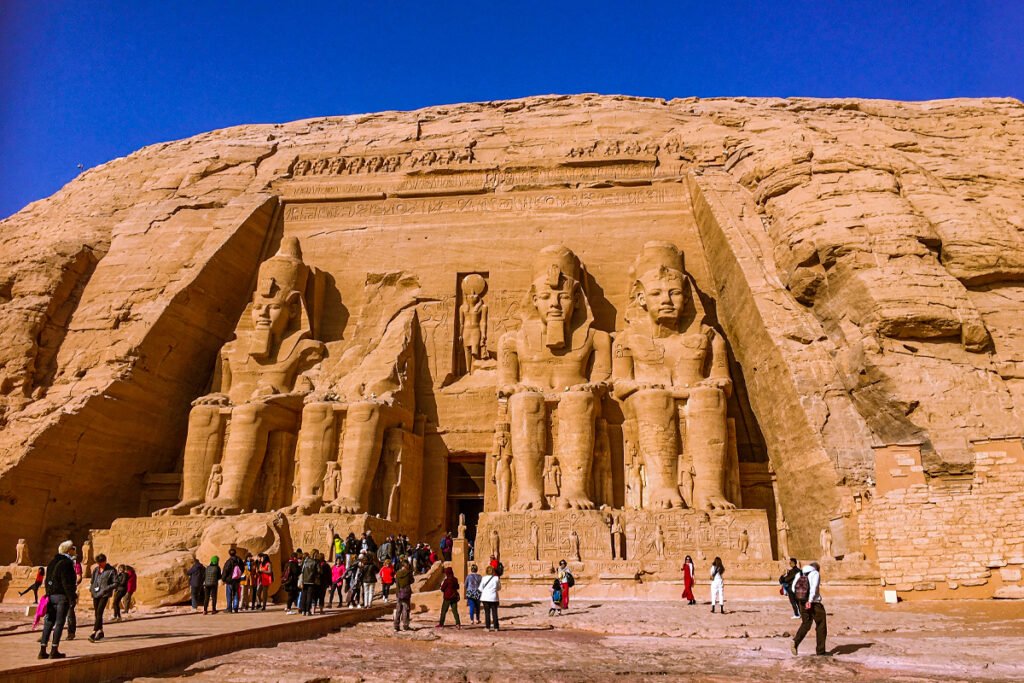
Egypt is not only about the pyramids and the Nile—it is also home to one of the most awe‑inspiring and historic places in the world: The Abu Simbel Temples. Carved into the sandstone cliffs of Nubia, this UNESCO World Heritage Site attracts travelers, history lovers, and culture seekers with its colossal statues, astronomical precision, and timeless legacy. This article will explore the wonders of Abu Simbel and why it should be on your Egypt travel list.
The Sacred Setting: The Temples of Ramses II and Nefertari
On the western bank of Lake Nasser, about 290 km south of Aswan, lies the Abu Simbel Temple Complex. Built in the 13th century BC by Pharaoh Ramses II, the site consists of two temples:
- The Great Temple, dedicated to Amun‑Ra, Ra‑Horakhty, Ptah, and Ramses II himself.
- The Small Temple, dedicated to the goddess Hathor and to Ramses’ beloved queen, Nefertari.
The façade of the Great Temple is dominated by four colossal seated statues of Ramses II, each about 20 meters high, guarding the entrance like eternal sentinels.
A Living Monument with Ancient Treasures
Inside the temples, visitors can discover:
- The Hypostyle Halls, supported by Osirid statues of Ramses II.
- The Sanctuary (Holy of Holies), where statues of Amun‑Ra, Ra‑Horakhty, Ptah, and Ramses II sit in eternal silence.
- The Solar Alignment Phenomenon: Twice a year, on 22 February and 22 October, the rising sun illuminates three of the statues in the sanctuary, leaving Ptah, the god of the underworld, in shadow. This precise alignment is one of the greatest astronomical achievements of ancient Egypt.
Spiritual and Cultural Significance
Abu Simbel was more than a temple—it was a political and spiritual statement.
- It symbolized Egypt’s dominance over Nubia and served as a warning to anyone approaching from the south.
- It blended religion, astronomy, and royal propaganda, glorifying Ramses II as both king and god.
- The smaller temple of Nefertari is unique in Egyptian art, as the queen’s statues are carved equal in size to those of the king—a rare honor that reflects her importance.
Rediscovery and Relocation
For centuries, the temples lay buried in sand until 1813, when Swiss explorer Johann Ludwig Burckhardt rediscovered them.
In the 1960s, with the construction of the Aswan High Dam threatening to submerge the site, UNESCO launched a historic rescue mission. Between 1964 and 1968, the temples were carefully cut into blocks and relocated to higher ground—an engineering feat that remains one of the greatest archaeological preservation projects in history.
Exploring Abu Simbel Today
Today, Abu Simbel is a UNESCO World Heritage Site and one of Egypt’s most visited attractions. Thousands of visitors gather each year to witness the solar alignment phenomenon, celebrating the genius of ancient Egyptian builders. The surrounding Nubian culture adds another layer of richness, with local markets, music, and crafts offering a warm welcome to travelers.
Safety and Accessibility
Abu Simbel is a secure and well‑maintained site, regularly visited by international travelers. Daily flights and buses from Aswan make the journey convenient, and guided tours ensure a smooth and informative experience.
Frequently Asked Questions (FAQs)
Q1: Why is Abu Simbel famous?
It is renowned for its colossal statues, solar alignment phenomenon, and its relocation by UNESCO in the 1960s.
Q2: Can visitors enter the temples?
Yes, visitors can explore the halls, sanctuaries, and admire the detailed carvings inside both temples.
Q3: What is the best time to visit Abu Simbel?
From October to April, when the weather in southern Egypt is cooler and more comfortable.
Q4: How do I get to Abu Simbel?
It is located about 290 km south of Aswan. Visitors can reach it by plane, bus, or as part of a guided tour.
Q5: Is it safe to visit Abu Simbel?
Yes, the site is secure and regularly visited by both locals and international travelers.
Conclusion
Visiting Abu Simbel is more than a trip—it is a journey into history, power, and artistry. From the colossal statues of Ramses II to the delicate carvings of Nefertari, every corner of the temples tells a story of ambition and devotion. Combined with the beauty of Lake Nasser and the warmth of Nubian hospitality, Abu Simbel offers an unforgettable experience for travelers seeking both wonder and connection with the ancient world.